The rapid growth of data centers is reshaping how modern networks are built, operated, and monitored. Driven by cloud adoption, edge computing, and the rising demand for digital services, network infrastructures are becoming more distributed, more complex, and more energy-intensive than ever before. In this environment, traditional network monitoring and management tools are no longer sufficient.
Organizations need holistic software solutions that not only provide end-to-end visibility across heterogeneous network environments, but also extend beyond pure connectivity metrics. Today, effective network management must integrate environmental monitoring – such as power consumption, cooling efficiency, and other operational KPIs – to ensure performance, sustainability, and cost control. Only by bringing network and infrastructure data together into a single, coherent view can operators truly understand, optimize, and future-proof their data center operations.
What is Data Center Environmental Monitoring?
Data center environmental monitoring refers to the monitoring of environmental conditions in a data center, such as temperature, humidity, and energy consumption.
It is an important component in the overall management of a data center. After all, what good would monitoring the IT infrastructure and network components alone be if the cooling system failed and the systems overheat and crash due to excessive temperatures?
In holistic data center monitoring, it is therefore important to monitor all parts and factors that affect performance and availability. This helps ensure the data center runs reliably.
Examples of environmental KPIs
Each data center is unique in its set-up and infrastructure and has therefore different requirements. That is why the KPIs and data points relevant to data center operators are as individual. Let’s take a closer look at a few possible key figures below:
KPI 1: Power consumption of individual devices
In our heterogeneous landscape of various device models and vendors it is self-evident that not every device consumes energy equally. This holds true for devices with comparable specifications. Monitoring individual devices can help in pinpointing either underperforming especially well performing hardware.
KPI 2: Temperature differences
Monitoring temperature differences between outside and inside as well as cold and hot aisle is important. This helps to keep the cooling consistent and to meet service level agreements. High temperature differences are one of the first indicators of unoptimized airflow, equipment failure or the necessity of maintenance.
KPI 3: Power Usage Effectiveness (PUE)
PUE = total facility energy / IT equipment energy [1]
Power Usage Effectiveness (PUE) measures how efficiently a data center uses energy, comparing energy consumptions of the total facility to that of the IT equipment. A lower PUE means less energy wasted on cooling, lighting or other overhead systems. This means it allows the operator to identify inefficiencies in their data center.
KPI 4: Energy Intensity (EI)
EI = J / bit [2]
Energy Intensity (EI) describes the energy consumption per transmitted bit. It allows benchmarking across individual data centers thus creating a basis for comparison that helps data centers operate efficiently under load.
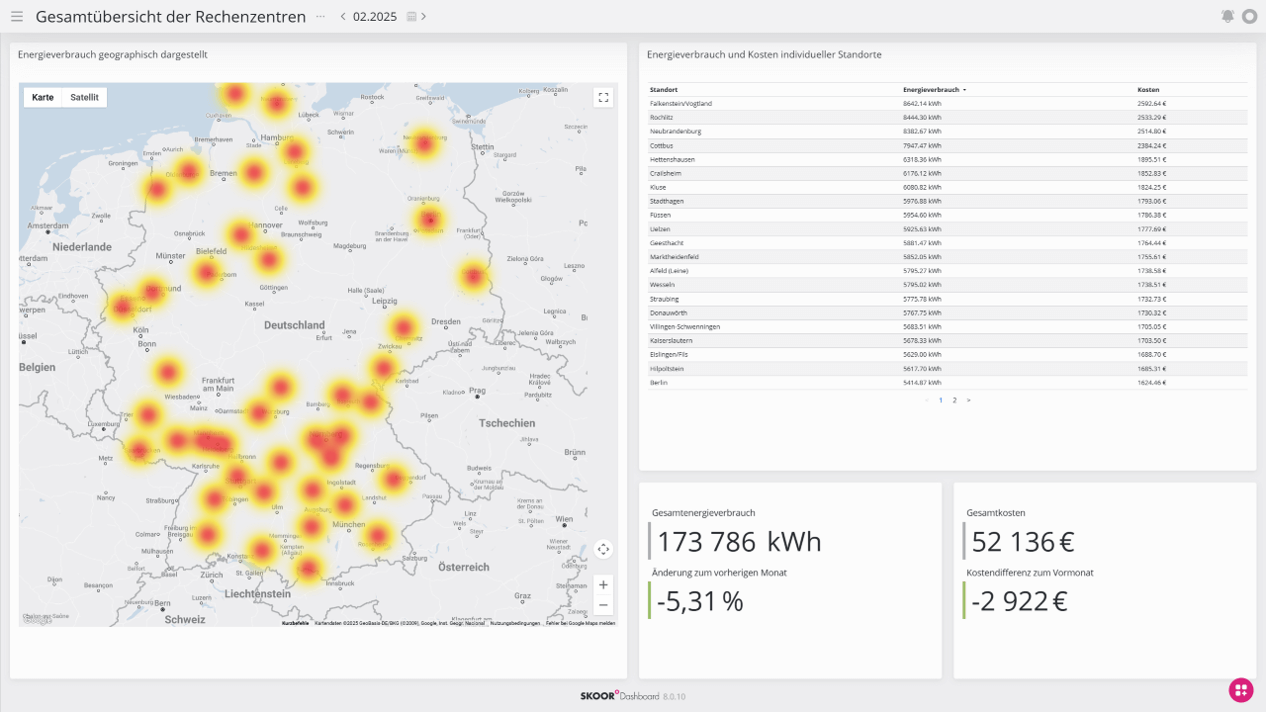
KPI 5: Total energy consumption and costs by location
In order to assess not only the performance of a single data center, but across all of your data centers globally, it is helpful to have a cross-location overview of energy consumption and costs.
In the end, the total consumption and cost figures are the key indicators for making sensible management decisions. Furthermore, the total energy consumption plays a key role in environmental reporting.
KPI 6: Total Operational Carbon Emissions
Carbon emissions (kgCO2) caused by data center operations are essential for environmental reporting and sustainability initiatives. This includes the monitoring of grid-supplied energy and on-site generated energy such as photovoltaic systems. Combined with their respective carbon intensities (kgCO2/kWh), this provides detailed insights into the time-dependent dynamics of emissions which forms the basis for further decarbonization measures such as dynamic work-load scheduling.
4 Key Benefits of Data Center Environmental Monitoring
Monitoring environmental factors in a data center, as an essential part of holistic data center monitoring, offers significant advantages.
Cost and resource efficiency
Data center environmental monitoring helps to make optimal use of resources and can contribute to reducing operating costs, e.g. for equipment maintenance, energy consumption, and potential system failures. If, for example, the temperature is kept constantly within the optimal range, unnecessary cooling costs can be saved and, at the same time, overheating can be avoided, which in the worst case can affect the longevity of the hardware.
Sound basis for decision-making
By monitoring and analyzing environmental factors, business managers gain important insights into the health and efficiency of the data center. On this basis, business decisions, resource and capacity planning, and optimization measures can be made faster, easier, and more efficiently.
By setting individual thresholds and automated alerts, deviations from the norm can be identified and adjusted at an early stage before they become major problems. This enables high availability and reliability to be achieved, which is necessary to comply with service level agreements (SLAs).
Compliance with regulations
Comprehensive insight into the environmental conditions of a data center is important for providing insights to external stakeholders, customers, and internal management. Understanding energy use, power consumption, and emissions is important to meet legal regulations like the EU Taxonomy and the Energy Efficiency Directive (EED).
What should a data center environmental monitoring solution include?
Environmental monitoring should not be seen as a standalone solution. It should be part of a complete data center monitoring approach. A centralized view of all data center components on a single platform enables comparisons to be made and allows the performance of a data center to be viewed holistically.
Let’s look at a few key points that a solution should cover.
Data consolidation & normalization
A monitoring solution should be able to consolidate and normalize data from measurement technologies that use sensors to measure environmental conditions in a data center on a single platform. For holistic management, these environmental conditions should be combined with IT, network, and infrastructure data on one platform. This global view of all data center parts breaks down isolated data silos. It provides full transparency across physical, virtual, and hybrid infrastructures.
A monitoring solution should be able to inventory and map all devices and components of the data center infrastructure. This provides an important data basis for relating the measured environmental conditions, such as energy consumption, to the set-up and inventory of the data center.
Data alone is useless unless it is presented in a meaningful and clear manner. Dynamic live dashboards, charts, and graphs with drill-down capabilities are essential for a data center environmental monitoring solution.
A monitoring solution should allow role-based access and user-specific dashboard views. This way, each user only sees the information they need and are allowed to see. Preventing unauthorized access is particularly important for data centers, as they have highly stringent security requirements.
A comprehensive monitoring solution should enable correlations to be made between data. In addition, it should be able to link current data with historical data so that trends can be identified and forecasts can be made on this basis.
The ability to set thresholds and policies based on individual KPIs and SLAs, as well as the integration of automated alarm and fault management, means that deviations from the norm can be quickly identified and resolved.
A good data center monitoring solution should be able to create custom reports for different user groups. This includes management reports to help with business decisions and also compliance reports for customers and external stakeholders. These reports ensure that legal regulations and service level agreements (SLAs) are met.
Comprehensive Data Center Monitoring with StableNet®
StableNet
® delivers scalable and automated data center monitoring for complex IT environments. From the power infrastructure, IT equipment, and physical security to environmental parameters, StableNet
® monitors all components of your data center.
Learn more about it here:
StableNet® Data Center Monitoring