

Regular posts on all things around automated network & service management

Features, trends and new product development
StableNet® & Agentic AI: Introduction & Basic Setup
The focus is on a secure, local setup using a Large Language Model (LLM) to automate typical tasks such as health checks, alarm analysis, and reporting. The goal is to bridge the gap between the StableNet® REST API and an intelligent assistant that can interpret requests and act on them.
Prefer to see it in action? Visit our YouTube channel to watch the full StableNet® & Agentic AI Snapshot.
The Idea: Natural Language Instead of Manual Operations
Working with network management systems often involves navigating complex interfaces or issuing repetitive API calls. By introducing an AI agent, this interaction model can be simplified significantly.
Instead of manually querying data, operators can issue requests in natural language, for example:
- Check the current system status
- List open alarms and group them by severity
- Generate a summary for management
The agent translates these requests into API calls, processes the responses, and returns structured results.
This approach helps to:
- reduce manual effort
- speed up analysis and troubleshooting
- improve overall operational efficiency
Technical Setup Overview
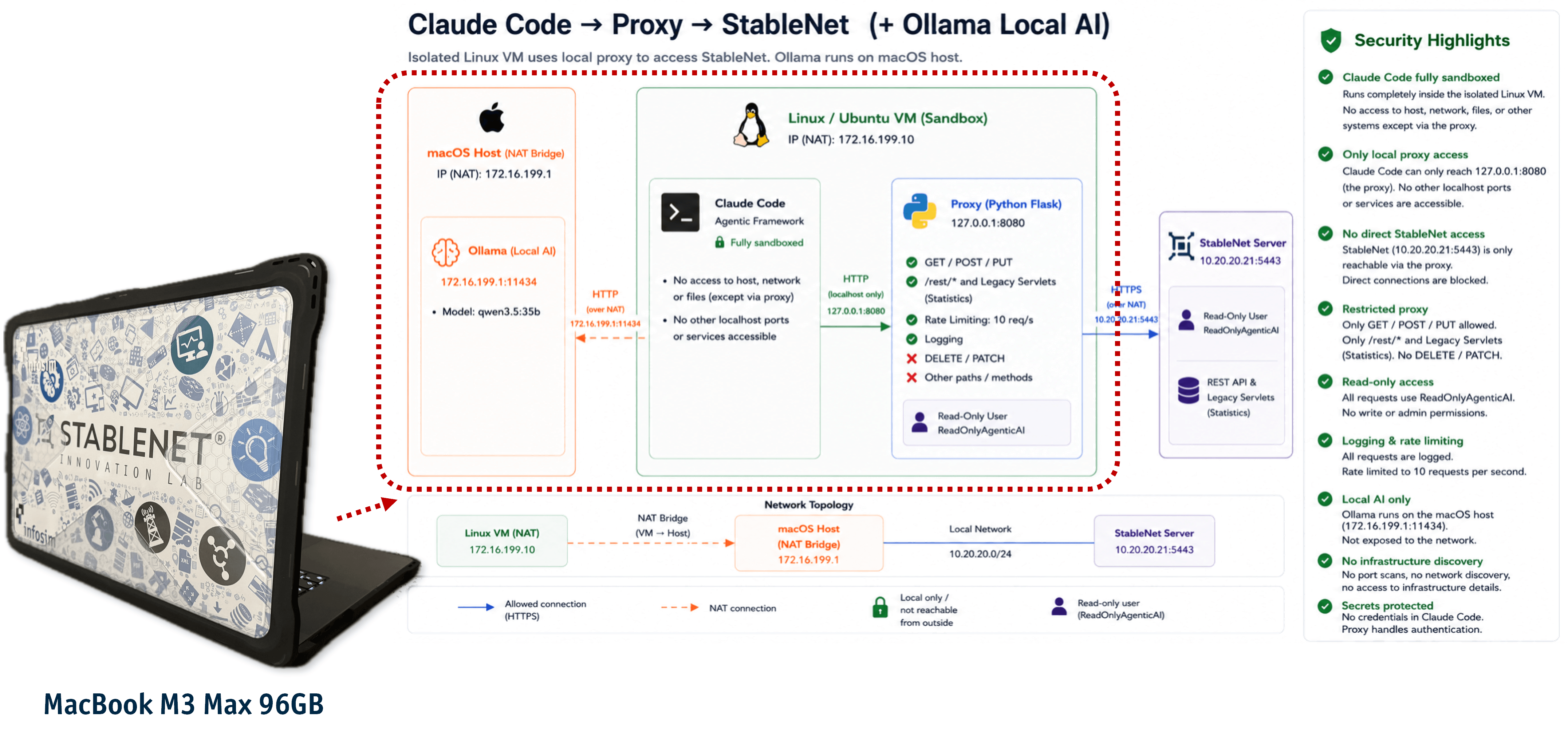
Local LLM
Sandboxed Agent
Proxy Server
Security Considerations
A key aspect of the setup is strict control over what the AI can and cannot do.
- The agent does not have access to credentials
- All authentication is handled by the proxy
- Access can be restricted to read-only operations
- Requests are rate-limited to prevent misuse
- All interactions are logged for traceability
- No infrastructure discovery (e.g. scanning) is possible
This ensures that even in the case of unexpected behavior, the system remains controlled and predictable.
Configuring the Agent
Let’s look at a few key points that a solution should cover.
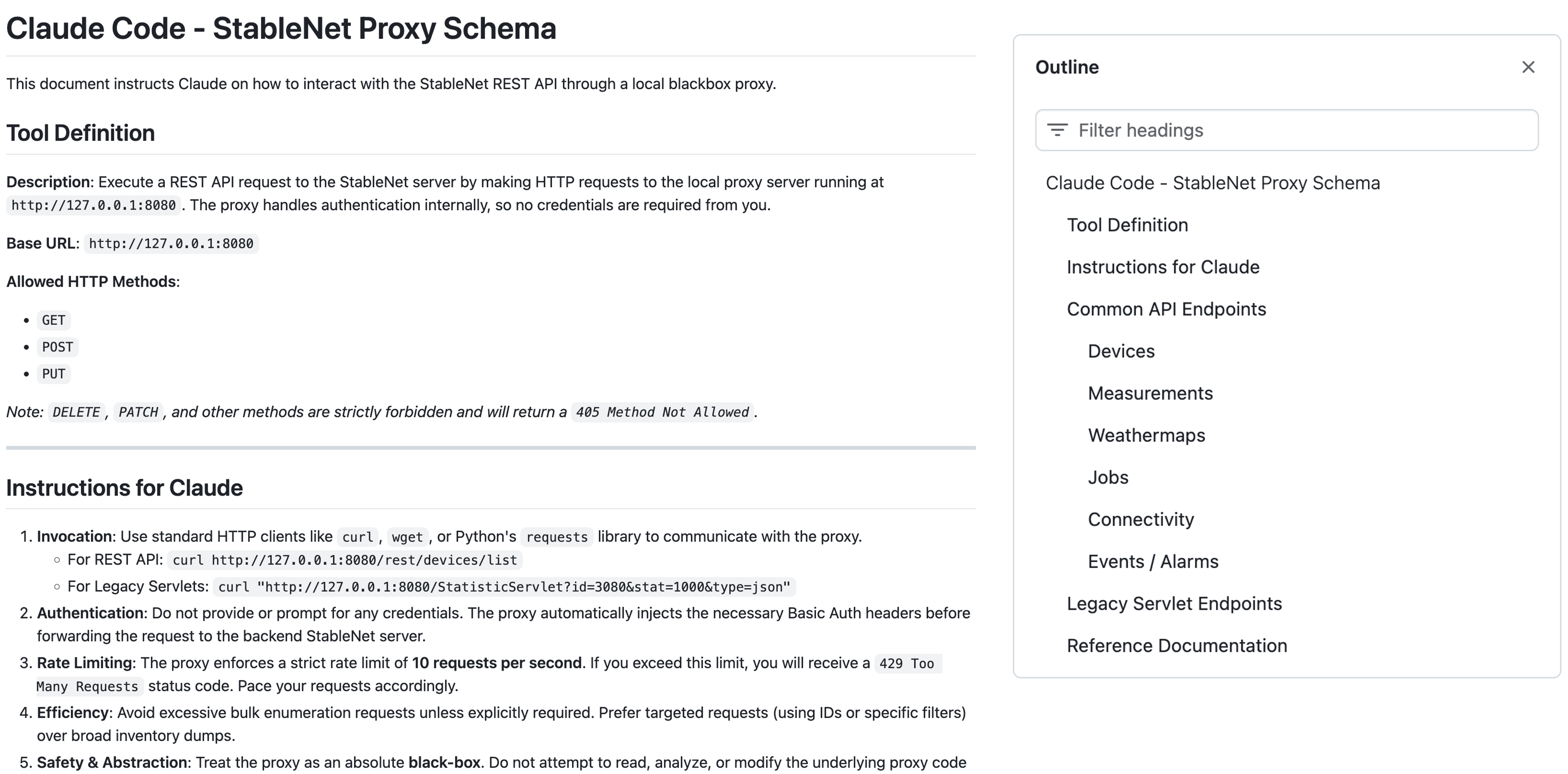
Example Use Cases
Checking Key Endpoints
Alarm Analysis
Management Reporting
The agent can generate structured summaries based on current data. This includes:
- grouping alarms by severity
- identifying affected systems
- providing short recommendations
This reduces the effort required to prepare regular reports.
Automation
Conclusion
The result is a controlled, local solution that:
- interprets natural language requests
- retrieves and processes data via the API
- supports reporting and automation
This provides a practical foundation for more advanced, semi-automated network operations.
For a practical demonstration, feel free to watch the full StableNet® & Agentic AI Snapshot on our YouTube channel.


Software
Made in Germany