



KIOptiPack
Holistic AI-based Optimization of Plastic Packaging with Recycled Content

General Information
Currently, only about 11% recyclates are used in packaging. This insufficient recycling of packaging waste causes damage to the environment and unnecessarily high climate-damaging emissions.
Reasons for the lack of recycling are various uncertainties in the market, which cannot be controlled by current competences, design processes, process control strategies and technologies as well as market structures and are additionally overlaid by the demands for minimum emissions.
Examples of such uncertainties:
- Low data availability and linkage, makes recyclate use economically unattractive.
- The high complexity due to many influencing variables, such as polymer preparation, material development/manufacturing and processing procedures, cannot be managed by companies.
- No holistic evaluation method for the value chain of plastic packaging, which enables holistic optimization as well as cycle-compatible packaging design
- Lack of business models
Project Goal
The objectives of KIOptiPack are to develop tools for the entire value chain (secondary raw material – material and packaging development – process design – packaging production – consumers):
- AI-supported tools for successful product design and quality production of plastic packaging with a high recycled content
- AI application and data space based on Gaia-X
- Central network platform for value engineering
Infosim® – Our Focus
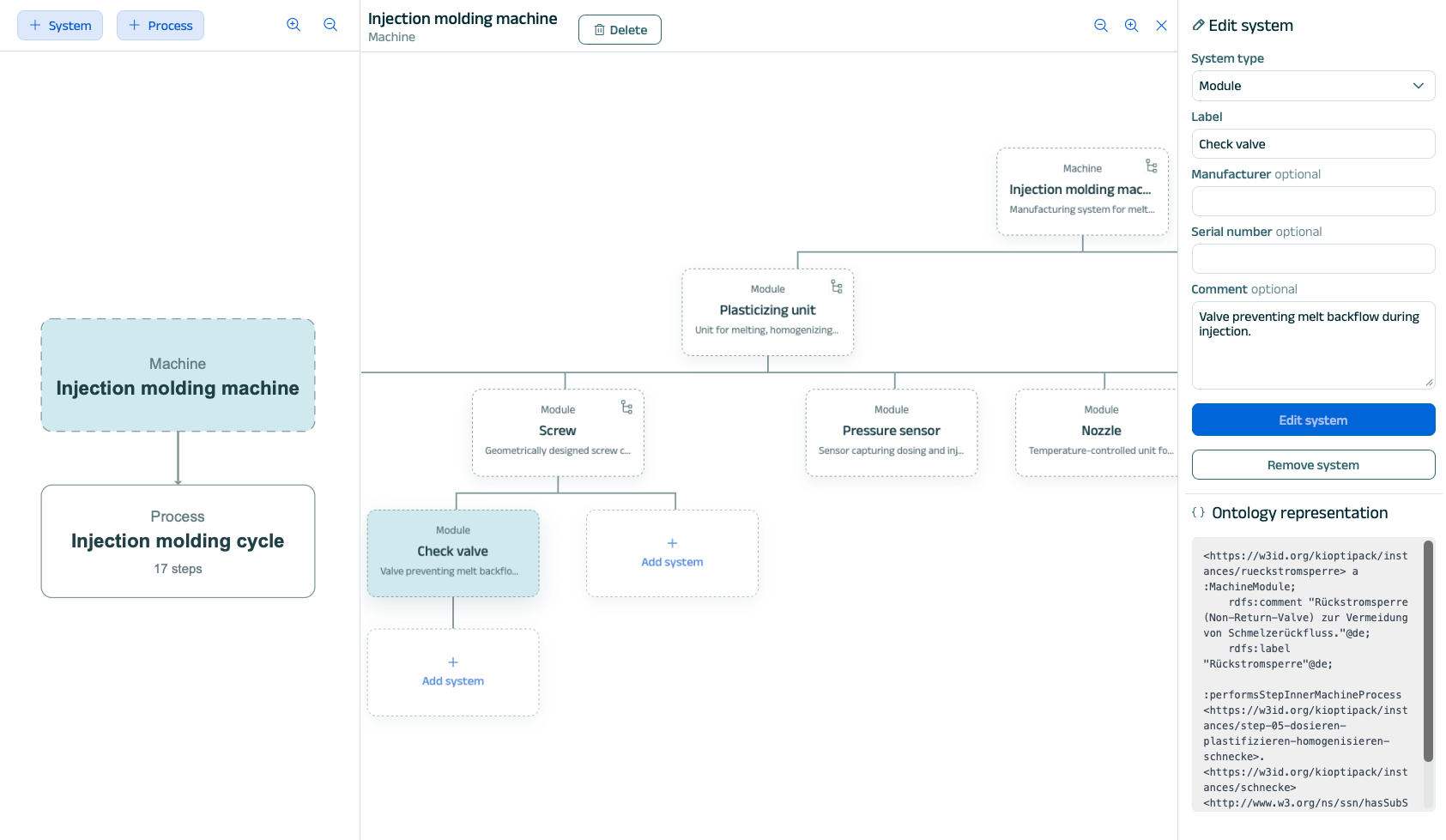
Within KIOptiPack, Infosim® contributed to the development of a base ontology for the initialization of machines, machine modules, and sensors. Building on this foundation, Infosim® designed and implemented a browser-based graphical user interface enabling users to instantiate and configure the ontology in an intuitive, task-appropriate manner.
The work resulted in a dedicated graphical modeling tool for manufacturing processes and facilities, which automates the generation of ontology instances for all modeled entities. This tool effectively bridges the gap between domain expertise and semantic data modeling, lowering the barrier for non-specialist users to contribute to a structured, machine-readable representation of production environments.
For further information please visit the Project Website.
Back to the Project Overview


Software
Made in Germany
Software
Made in Germany